








![[Slideshow] Senior Prom 2026: A Night to Remember Before Graduation](https://randolphrampage.com/wp-content/uploads/2026/06/Image-70-1200x900.jpeg)
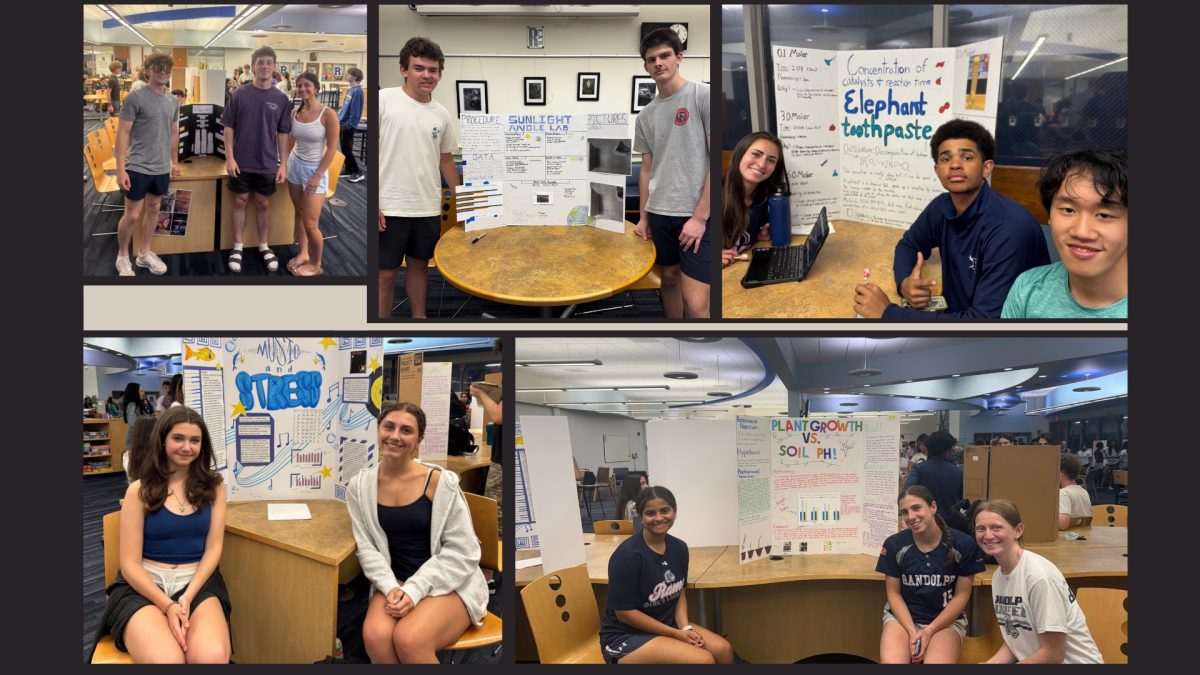






The Science National Honors Society (SNHS) once again brought science to life with the 2026 Science Fair, held on Wednesday, May 20, in the RHS Media Center.
The fair highlights months of SNHS members’ hard work, dedication and commitment to researching a topic of their choice and presenting projects that explore everything from environmental science to chemistry and engineering.
“Some students were conducting their research as early as January,” said Andrew Palmer, SNHS advisor and RHS science teacher. “This is a great opportunity for our scientific scholars to practice the scientific approach to dive further into an area of their interest.”
Rampage staff visited this year’s fair to take a closer look at the presentations and the students behind them. –Josh Dobis
The Effect of Added Mass on Battery Efficiency
Seniors Zachary Jewel and Siddharth Vadali researched how added mass affects battery efficiency in vehicles.
“I hope people can better understand the effects that carrying extra mass and different leads can have on vehicles,” Jewel said, “especially in a changing time that is more focused on efficiency and environmental consciousness.” –Josh Dobis
Concentration of Catalysts and Reaction Time | Elephant Toothpaste
Juniors Nathan Li, Jonathan Ford and Ana Sharkey explored how different concentrations of catalysts affect reaction time through the classic “elephant toothpaste” experiment.
Using sodium iodide to speed up the decomposition of hydrogen peroxide, the group tested concentrations of 0.1 molar, 3.0 molar and 6.0 molar. Their results showed that the 6.0 molar solution produced the fastest reaction.
“Experimenting with the chemicals and the decomposition of hydrogen peroxide was really fun to see and test out,” Ford said. –Jordan Jacobs
Music and Stress
Seniors Keili Semler and Lilliana Colasante studied whether low-tempo music could reduce stress and anxiety levels.
Participants were asked to organize a list of words alphabetically within two minutes. During the first trial, no music was played. During the second, participants listented to low-tempo music. On average, participants recorded lower heart rates while listening to music.
“We wanted to do something applicable to high schools but also something manageable to complete in the two days we had to make the presentation,” Colasante said. –Jillian Liebhauser
Microplastics: Measuring CO₂ Production Through Balloon Circumference
Juniors Elisabeth Latch and Josephine Schiedel created a project focused on the environmental effects of microplastics and cardon dioxide production.
Using balloons, flasks and controlled experiments, the students measured changes in gas production under different environmental conditions. Their display featured colorful charts, photographs and detailed explanations of their findings.
“This project is really important because it helps us understand how things like microplastics and CO₂ can affect the environment in ways we don’t always see in everyday life,” Latch said. –Ava Sousa
Sunlight Angles Lab
Juniors Brayden Hendrickson and Mark Hurley investigated how much the angle of sunlight affects temperature.
Using a lamp like the sun and a cardboard box to represent Earth, the students measured temperature changes at different light angles with a thermometer.
“The data showed that the more direct the angle the sunlight, the hotter it gets,” Hendrickson said. “The most interesting part was its effect on solar panels in that modern ones can adjust to the sun’s location, so the angle isn’t as big of a factor.” –Drew Milberg
Plant Growth vs. Soil pH
Seniors Cassidy Smith, Ashley Silvestri and Katelyn Ford explored how household liquids and soil pH levels impact plant growth.
The group tested liquids with varying acidity and basicity levels on lavender seedlings. Their findings showed that plants watered with more neutral liquids, such as regular water, experienced the healthiest growth, while highly acidic or basic liquids slowed development.
“We learned that plants grow best when the pH is more balanced,” Smith said. “It was interesting to see how even small changes in pH could affect the plants.” –Aedan Perez
Insecticide Effectiveness
Juniors Russell Goldstein, Ethan Dougherty, Kayla Hudak and Valarie Reynaldo studied whether higher concentrations of bug spray repel more insects.
“The tests were very interesting, and we were surprised we caught bugs such as wasps,” Goldstein said. “In all, we found the importance of wearing bug spray.”
Their experiment showed that higher concentrations of bug spray were more effective at repelling insects. –Jackson Stein
Do Sunglasses Work?
Seniors Justin Swayze, Reina Daniel and Chase Lorent explored how effective different sunglasses are at reducing light intensity.
The group shined a flashlight at a fixed surface with two different types of sunglasses in front of the light source. Their findings showed that the Oakley sunglasses were most effective at blocking light.
The students also concluded that as distance and darkness increase, light intensity decreases.
“Our group wanted to research this topic because sunglasses are an everyday use for us,” Swayze said. “We want to be protected at all costs, so seeing how effective each pair of sunglasses was helped us out.” –Ian Pietrucha
How Pineapple Impacts Gelatin Solidification
This experiment examined how pineapple impacts the solidification of gelatin and whether different forms of pineapple change the results.
Students compared fresh pineapple, canned pineapple, heated pineapple and a control group with no pineapple added. The results showed that fresh pineapple prevented gelatin from fully solidifying and created the weakest gel.
The team shared that this project was “super fun to do because we got to understand how something as simple as pineapple could be changed just because you canned it.” –Kaitlyn Brown
The Science Fair offers students an opportunity to turn their interests into meaningful scientific research. Many of the projects reflected advanced experimentation and analytical skills often seen in college-level studies, demonstrating the dedication and curiosity of RHS student researchers.